A new market can look attractive in a spreadsheet long before it is reachable in real life. A population estimate is not a customer, a competitor’s presence is not proof of fit, and a launch date is not a route to market. The executive task is to turn a broad opportunity into a series of commercial questions that can be answered with evidence.
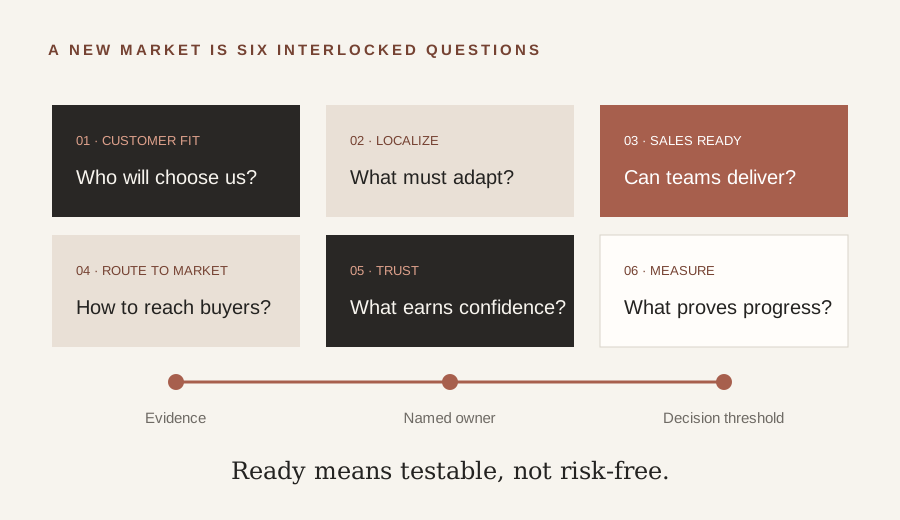
Test fit before sizing the prize
Begin with the customer problem. Who has it, how is it handled today, and what evidence shows the proposed offer is meaningfully better? Which customer segments can the team serve with its current product, economics and operating model? Separate a theoretical total market from the reachable demand the organization can serve with a credible proposition.
Look for behaviour, not just stated interest: purchase cycles, switching costs, channel preferences, decision roles and willingness to pay. Interview customers and channel partners, review competitor offers and test the assumptions with a small, measurable pilot. A useful market-entry case says what would disprove the opportunity as clearly as it says what would support it.
Localize the experience and the operating model
Localization is not a translation project at the end of launch planning. It can affect product features, service hours, payment options, price architecture, customer support, sales materials and the way a company earns trust. Check local rules with qualified local counsel and the appropriate specialists; do not treat a general regional checklist as legal advice for an individual country.
Trust is part of conversion and retention. Consider how customers evaluate the company, what proof they need, which partners lend credibility and how complaints will be resolved. A market may require a different blend of direct sales, resellers, distributors, marketplaces or strategic partnerships. Each route changes control, margin, access to customer data and the time required to learn.
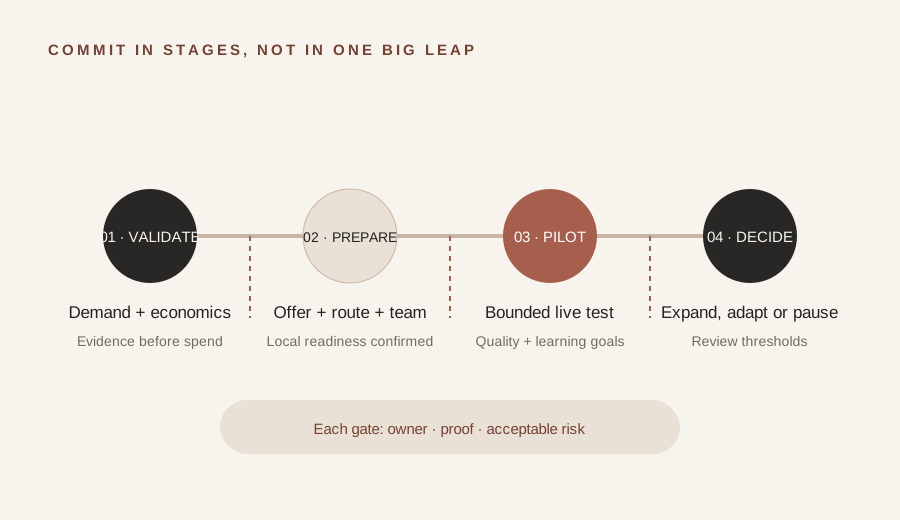
Make sales readiness a launch gate
Sales readiness means more than a deck and a target. Confirm that the team knows which customers to pursue, how to explain the value in local context, what proof points are available, how pricing exceptions work and who can resolve delivery questions. Train customer support and operations alongside sales. If the promise depends on capabilities that are not staffed or integrated, the market is not ready simply because the campaign is.
Define the first commercial measures before launch: qualified conversations, conversion by stage, sales-cycle time, average contract economics, activation, service quality and retention signals. Decide how leads and opportunities will be recorded, who owns qualification and how long the team will wait before reading an early cohort. Add customer feedback and trust indicators, not only acquisition costs.
Use uncertainty as a design input
Market conditions can change faster than an annual plan. The World Bank’s April 2026 regional economic update projected a 4.3% contraction for GCC economies in 2026 amid disruption to trade and oil production associated with the Strait of Hormuz closure. That is a dated regional forecast under an exceptional scenario, not a forecast for every GCC country or a substitute for current country-level diligence. Its practical lesson is to scenario-test assumptions and revisit them as conditions change. Read the World Bank update.
Set thresholds for the next commitment: what level of qualified demand, route-to-market performance, customer satisfaction and unit economics justifies expansion? Which signals require another test? What would trigger a pause? The numbers will differ by business. The discipline is to agree on them before launch pressure makes every result look like a reason to continue.
GTM Ready GCC is a self-directed, rule-based prototype that organizes questions about commercial readiness for Gulf market entry. It is a planning aid, not country-specific legal guidance, a client deployment or proof of market outcomes. The same sequence of fit, localization, sales readiness, route, trust and measurement can help teams assess opportunities beyond the Gulf, with the local evidence and expertise each market requires.
Sources & further reading
- World Bank, Middle East, North Africa, Afghanistan and Pakistan Economic Update, April 2026. Regional 2026 forecast; scenario-specific and not uniform across countries.