Generative AI is changing how people discover information, compare options and form a first impression of a brand. That shift deserves attention, but it does not make every AI mention a customer, every generated summary a recommendation or every new tool a business case. Marketing leaders need a clear view of where discovery is changing and an equally clear system for deciding what to do about it.
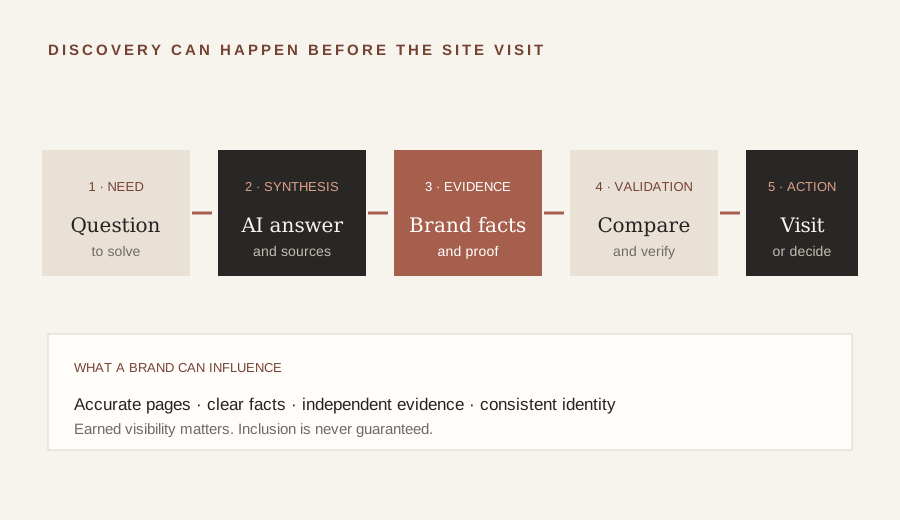
Visibility still depends on useful, trustworthy information
Search behaviour is changing, and the evidence should be read with its limits attached. Pew Research Center analyzed browsing activity from 900 US adults in March 2025. In that study, users clicked a traditional search result on 8% of visits when a Google AI summary appeared, compared with 15% when no summary appeared; they clicked a source link inside a summary in 1% of visits. These observations describe one country, one search engine, one month and one research method. They do not establish the same pattern for every market, query or platform. Read the study.
Google’s current guidance says there are no additional technical requirements or special schema needed to appear in AI Overviews or AI Mode. Its guidance points back to crawlable pages, helpful and reliable people-first content, clear internal links and accurate structured data. In other words, there is no reliable shortcut that replaces a useful answer and a sound site. Read Google Search Central’s AI features guidance.
For a brand, trust is built from the fundamentals: accurate product information, named expertise where appropriate, consistent facts across owned channels, current policies, accessible pages and evidence that a human can inspect. Publish material that answers real questions clearly. Make important claims traceable. If an AI system or a customer cannot tell what is current, who stands behind it and where to verify it, more content will not fix the underlying problem.
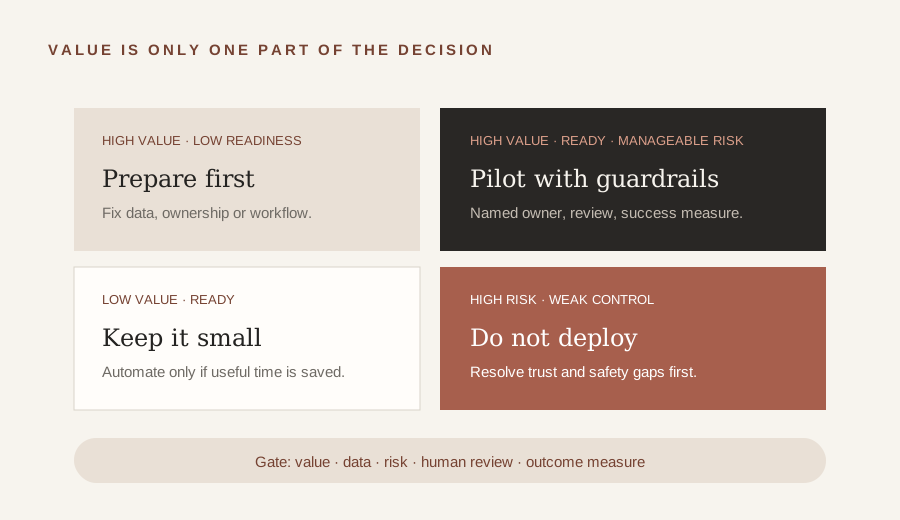
Choose use cases with an owner and a stop rule
Start with a costly or slow business task. Name the user, the workflow, the current baseline and the decision the system might improve. Then assess data quality and access, integration effort, privacy, security, intellectual property, bias, brand risk and the consequence of a wrong answer. Some use cases need a model; others need better search, automation, clearer process or no new technology at all.
Set the operating guardrails before the pilot: approved data, permission boundaries, review requirements, escalation paths and a named person accountable for the final output. Decide which outputs can be used directly and which must be checked. Keep the human review proportional to the consequence. A draft of an internal outline and a recommendation affecting a customer deserve different controls.
Agree on success measures before the first demo. Depending on the work, these may include cycle time, accuracy against a reviewed reference, rework, customer satisfaction, adoption, cost to serve or incremental revenue. Track quality and risk alongside speed. Compare with a baseline or a suitable control when feasible, and capture the full cost of integration, supervision and maintenance. Define what evidence will justify scaling, what will trigger revision and what would stop the experiment.
Move from adoption to business impact
McKinsey’s 2026 global survey of 1,719 respondents across 97 countries found that nearly nine in ten reported regular AI use in at least one business function, while 44% said AI was scaling across their enterprise, up from 38% a year earlier. Only 6% met the report’s definition of AI high performers, including reported EBIT impact of at least 5% and significant value. These are survey responses, not a causal estimate of AI’s return; the gap between adoption and value makes workflow redesign, ownership and measurement central. Read the State of AI report.
Two prototypes in this portfolio illustrate different methods. AI Readiness Check uses deterministic, rule-based logic to organize readiness questions. Investor IQ uses an LLM to turn a conversation profile into a structured draft informed by a psychographic framework, with human judgement still required. Both are self-directed prototypes, not client deployments or proof of commercial impact. Their value is in making a method discussable and testable.
For executives, accountable AI is a portfolio of decisions, not a race to accumulate tools. Choose fewer use cases with clearer ownership. Protect the customer’s confidence as carefully as the team’s time. And keep the discipline to stop when the evidence says a use case is not earning its place.
Sources & further reading
- Pew Research Center, Google users are less likely to click on links when an AI summary appears, 22 July 2025. US browsing data from 900 adults in March 2025.
- Google Search Central, AI features and your website. Official technical guidance for AI Overviews and AI Mode.
- McKinsey, The state of AI in 2026: On the road to ROI, 25 August 2026. Survey of 1,719 respondents in 97 countries; reported adoption and impact are self-reported.